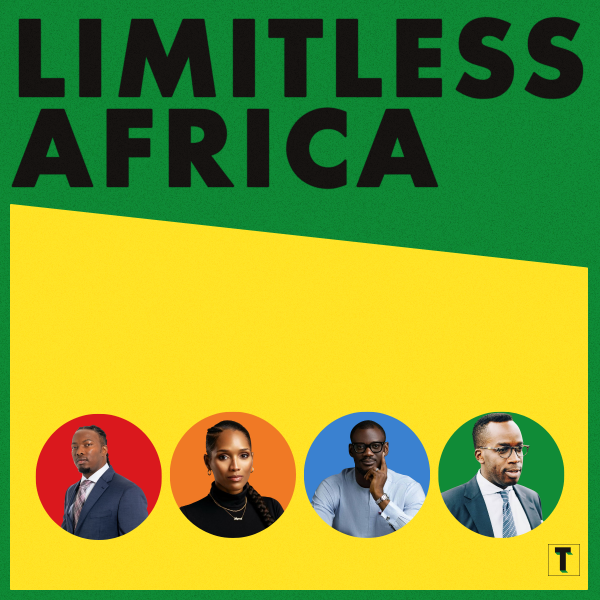
Host: I really love in this latest season how we’ve been able to shine a light on Africa’s limitless potential. And I want to say one of the great privileges of hosting Limitless Africa [with Dimpo] is that we’ve been hearing extraordinary thinkers, leaders, artists, writers, just doers articulate what Africa’s future could look like when Africans take ownership of their own narrative
… to get beyond the Africa rising narrative, beyond the failed continent stereotype, and basically beyond all those cliches.
Host: I really love in this latest season how we’ve been able to shine a light on Africa’s limitless potential. And I want to say one of the great privileges of hosting Limitless Africa [with Dimpo] is that we’ve been hearing extraordinary thinkers, leaders, artists, writers, just doers articulate what Africa’s future could look like when Africans take ownership of their own narrative
… to get beyond the Africa rising narrative, beyond the failed continent stereotype, and basically beyond all those cliches.
So we ask all our guests this question: when it comes to Africa’s limitless potential, what should we be talking about that we’re not talking about.
Tomiwa Aladekomo: “Okay. I don’t know what the rest of the world should be talking about. I do know that Africa needs to take charge of its own future. I really think it is the most critical thing.
Host: That’s Tomiwa Aladekomo, a Nigerian media executive and internet entrepreneur.
Tomiwa: And I think ultimately that a thriving Africa is better for the world than the Africa that we have today. And so even as trade partners, even as resource partners, I think that a stronger, better, better educated Africa is actually better for the world than what we have today.”
Host: And when it comes to that world, we can’t shut it out. Diversity has always been our strength. And it’s also been crucial to other global success stories.
Jean-Claude Homawoo: I think one of the things that we don’t talk about enough is that if you really unpack, right, which is the regional entrepreneurial story that inspires us all?”
Host: Jean Claude Homawoo is building a logistics company in Kenya, but he was trained in the US
Jean-Claude: Silicon Valley, right? and And the thing that is often missed about that success story is who actually built it. Right.
And what I can tell you about it is that it was not just a bunch of San Franciscans. Right.
It wasn’t a bunch of third generation San Franciscans. It took a village of Russian entrepreneurs and Poles and African entrepreneurs and people coming from all parts of Europe and Latin America, etc.
That’s the reality. The reality is that the Silicon Valley story was not a sort of purely American nationalistic story.
And what I’m seeing across the continent is very similar. right What built Silicon Valley was diversity. It was diversity of thinking, diversity of experience. you know People that had grown up in in a communist Europe moving to the US and enjoying you know the the freedom and liberties and and and education system of of of you know the the West Coast and and working together to to build phenomenal companies.
And I honestly think that a similar story is built but and being built here. I think the thing that we don’t talk about enough is that it is taking the same level of diversity to to fuel and to power African entrepreneurship and African growth.
and And that is a good thing, right? I think the few times you hear people talk about it is kind of a little bit of ah of a tinge of of of African nationalism. And I’m always the first one to stand up and say, no, no, no, no.
No, no, no. We’re not going to build this ah by ourselves. Right. We’re going to build this because a number of different people actually leave the U.S. And so, you know what, I’ve you know, um I’m ready to try something different and move to Kenya, move to Lagos, move to South Africa, move to Rwanda and decide to bring everything that they’ve learned wherever they’re from, ah mix it in with the local culture, mixing it with a Nigerian co-founder or Kenyan co-founder or whatever, and end up building something that is not just built for Africa, but is built for the world. So I think diversity is the thing that we’re not talking about enough that was the recipe to success in Silicon Valley.
Host: And our diversity stretches across the globe. Claude spoke to Molly Jensen, the CEO of Afripods, a Africa focused podcasting platform. She moved from New York to Nairobi.
Molly Jensen: I got it so I would say that what we need to talk about is not just what is happening in Africa or what’s being created in Africa. But we need to just, when we talk about Africa, I think people look at like the GDPs of the country or how much is being spent and sometimes discount it.
What we need to realize is that the financial impact of African creativity is not just realized on the continent, but it’s also felt in the diaspora. And what I mean by that is that when you look at these huge Afrobeat musicians or these clothing brands, without their impact and and the the experience of being on the continent or using the fabrics or just feel like the being of Africa or African is so monetizable. And the fact that that is being received in the diaspora, that same money should be coming to the continent.
Because there are so many untold stories. There’s so many brands that haven’t been discovered. There’s so many spaces that that just need that funding. And so I would say, to reiterate, Africa’s impact is not the financial impact of what’s being created in Africa should also be realized on the continent and not just in the diaspora, if I could word it that way.
Host: Africa’s cultural, technological, and intellectual movements have this ability to ripple across the diaspora and ultimately shape the entire world.
And I think what you’re saying, Claude, about the diaspora is so important because art and culture is one of the main ways that we are able to connect with one another as Africans in many different parts of the world.
Bame Pule: I believe that art is the way to centre Africa and the global conversation. And I also believe that art is the way for us as Africans to recognize and realize our worth and potential.
Host: That’s Bame Pule. He’s not an artist. Or a curator. He actually runs a private equity company in Botswana. But he thinks art is central to changing how we talk about Africa.
Bame: When I’m talking about science with people in Shanghai, or I’m talking about innovation with people in New York, or I’m talking about finance with people in London, um we’re never really centering Africa in those conversations.
Those conversations tend to be about the US, Europe, and China, and Africa can be quite peripheral, actually, in those conversations. But when we talk about art and culture and music, then Africa is centered and the people with whom I’m having that conversation know an African musician or song or artwork.
And so in seeking to make sure that Africa is centered in every discussion of science, of investment, it’s important to bring art into the mix because those same people appreciate and know of African art.
And so I find that um it becomes important then to invest in African art and culture in order to center ourselves and our continent and our market and our youth and our potential in the global conversation.
Equally important as that outward facing conversation Claude, I think also an internal in-house, so to speak, conversation within the continent about art is very important.
Given our history as a continent, we do have issues of recognizing our history.
And the preservation of that culture has been disrupted through this history with colonization and so forth. And so I think it’s important to recognize the greatness in our African societies, um the beauty ah the wealth, um the great history, the the bad history, um the stories, um the many journeys, um the variety of experiences.
Taiye Selasi: I had a deep intuition that the way we would begin to shift the narrative, as we often talk about, around African potential, around African genius, would be through the creative arts.
I had the sense deeply early on, it would be through culture. I knew that because of what you’d done with Trace. I knew that because Chimimanda Adichie had just started publishing. I knew that because Zadie Smith was published.
Host: That’s Taiye Selasi, an award-winning Ghanaian-Nigerian-American author who runs a TV production studio. She was speaking to Claude from Kenya.
Taiye: Which I guess I would say brings me back to yesterday, you know, what the being in Nairobi, one of my favorite ah cities on the African continent with with it’s funny, the ah keynote, the keynote, this this is telling, Claude, the keynote of the African Creative Economy Summit in Nairobi, Kenya, was given by the white American Hollywood producer of the Apple series Severance.
You’ve got to watch it. You’ve got no time.
Why is the Hollywood producer behind Apple’s most profitable series in Kenya talking about the creative economy?
Because like all smart producers, he recognizes this is ah massive business opportunity. This is not giving away mosquito nets. This is tapping into the next great movement in creative output.
Bame: So I believe that by sharing African art with Africans … particularly the young people around the world, they can see greatness in themselves, they can see wealth and beauty in themselves and their societies and their countries and and and and the regions of Africa in which they’re in. And that can lead them to have greater self-understanding, self-worth, and ultimately even more aspiration than they would um without that.
Host: Africa is full of wealth and beauty. As Tomiwa put it, at the beginning of the episode, a thriving Africa is better for the world than the Africa that we have today. And that’s something we’ve heard throughout the series – from Taiye, and Molly and lastly from GNL Zamba whose words I want to leave you with… He’s a rapper from Uganda, who’s based in LA. He’s a wordsmith. and he answered in the most poignant way.
Claude: I want to finish with this question. What is the one thing we should talk about, but we don’t talk about enough when it comes to Africa’s limitless potential?
GNL Zamba: Here’s a thought, right?
In terms of Africa’s biggest contribution, I i believe, right?
I believe Africa is the the mother of everything. You get me? This might sound arrogant in a way, but it’s the mother of everything.
I look at so many parts of the world that have not yet healed because, once again, Africa has not stabilized. You get me? There is this gaping um continent with a lot of potential that has been denied trade, that has been denied peace just because of the curse of its minerals and its resources.
So there’s a conflict here because this is being mined to facilitate this product going forward. Some African countries are still paying debts on things they did not borrow and there’s leadership that is kept in place to perpetuate the stealing of resources.
There are places where minerals are discovered and you would think the citizens would be celebrating that, right? But the moment they discover oil or they discover new gold, all the people in the village are like, here comes the trouble, right?
Because they’ve seen it. They’ve seen it happen to their neighbours. They’ve seen it happen in other regions. I think morally, if Africa stabilises, the world’s just like a mother takes care of her children, right? The mother just needs to be at peace in order for the world to be at peace too. It sounds very, very simplistic, but until Africa stabilizes, we’re going to continue seeing so much turmoil elsewhere in the world because it stems from somewhere.
Claude: Yes, that’s a very simple answer.
Zamba: Spiritually, and yeah it’s a very, very simple answer.
Claude: Peace.
Zamba: It’s the peace. It’s the peace that needs to happen. and
Claude: I love this answer. I think it’s a very simple answer and it’s very satisfying to me. Thank you.
Zamba: Yeah. And ah you know how you know how complicated simple things are?
It’s as simple as you’re a human, I’m a human, we all come from the same birthplace, which is Africa. So all of us have a lot in common and we are different. You get me?
It’s the Ubuntu philosophy, but everybody just refers to the Ubuntu like it’s just this thing that’s floating in the air instead of actually practicing it and seeing it in real life.
Host: So, go back. Listen to the amazing Africans that we’ve featured on Limitless Africa this season.
If you’re going to ask me what I think – what we should be talking about that we dont talk about enough when it comes to Africa’s limitless potential… It’s confidence. We need the confidence as Thomas Sankara, BF’s independence leader might say, to are to invent the future.